
Yesterday I mentioned that I had finally discovered TEDtalks. I was watching the series on Artistry and Illusion. I was struck by Shea Hembrey and his talk “How I Became 100 Artists.” In this 16 minute talk/teaser, despite 3 minutes of talk about being a “hick," (his word, not mine), I wondered if I was one of those fortunate people who was experiencing-- through witnessing the talk--genius. And as they say, there is a fine line between genius and crazy.
 The focus of the talk was his Biennial S E E K. Instead of actually curating the show, finding the talented artists for the show and organizing the show, he decided it was “easier” to make up the artists and make the artwork himself.
Now, here’s where crazy comes into play. He developed back stories and biographies for each of the artists. In that back story, he identified what the focus of that artist’s work defined. As he talked, it got a little strange as he actually seemed to speak of them as if they truly existed, but then, we call a corporation an entity of itself, so…why not? There were moments when I wondered if, in fact, he isn’t completely bonkers with 100 or more distinct personalities. But then there was the admiring part of me that said….
 His work and energy somehow reminds me of other artists that I personally consider genius—Andy Warhol immediately came to mind, and Dale Chihuly, and a few others who have within their lifetime, transcended the art worlds’ condescension to become great—while alive. I wondered if, in fact, I was being exposed to genius. I admit to a little professional jealousy that I hadn’t thought of it first. What an astounding way to get your name on the map.
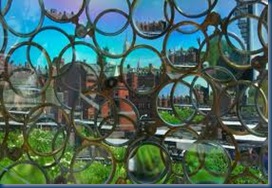 The gimmicky part aside, I wasn’t entirely sure if he wasn’t just poking fun at the art world and artists. Some (if not all—I have not seen the entirety of the collection) of his work genuinely is thought provoking, beautiful, inspiring and in turns meets my undefined expectation for what constitutes art.
I was astounded by the lengths he went with each “character” to create a work true to that artist. I especially loved the work of the fictional “Nell Remmel”—”Flipped Earth”—where he dug out a rectangle in the earth and put mirrors in the dirt (22’ long) reflecting the sky. The images are breathtaking. And Zen-like. And I want one in my yard (except for the "upkeep” part).
 When I finished watching the talk, I looked up Hembrey. I found Seek. You cannot see the entirety of the collection. I am not sure whether it was ever shown anywhere other than the talk. But, for a cool $1000 a pop, (just $10 per artist), you can purchase a limited edition (1000 copies) book with all of the artist’s bios and artwork included. I can’t help but believe that there are people who are/have bought this book. Curiosity is driving me crazy. If I had a disposable $1000, I’d own one (and see if I could get him—and all the artists to sign it!)
 So, crazy? Commercially parodying artists/art world? Genius? I don’t know. What I did find is that he has other artworks listed on his website. And there is a part of me that asks for each one, “are those real?” or did he “fake” those too.
 Besides the intensely creative solution he took to creating art and making a stir in the art world (and I’m sure that there are those who pooh-pooh him and this effort), what I love is that here is an artist who has made quality artworks in many mediums. What I saw were mostly pieces I could imagine seeing in a gallery. This flies in the face of what I hear time and time again that artists should “focus on one medium.” Yet what I find is that the real genius’ in art history did not focus on a single medium.
 I applaud Mr. Hembrey. I would definitely go to see his biennial and “meet the artists” (now there is a trick I’d like to see him pull off) and I continue to be disturbed and provoked. So all in all, a very successful biennial.
Frankly, I’m excited to see what next year’s biennial will hold from Mr. Hembrey since this was an effort he presented in 2011, my late discovery of it notwithstanding.

Now, here’s where crazy comes into play. He developed back stories and biographies for each of the artists. In that back story, he identified what the focus of that artist’s work defined. As he talked, it got a little strange as he actually seemed to speak of them as if they truly existed, but then, we call a corporation an entity of itself, so…why not? There were moments when I wondered if, in fact, he isn’t completely bonkers with 100 or more distinct personalities. But then there was the admiring part of me that said….
 His work and energy somehow reminds me of other artists that I personally consider genius—Andy Warhol immediately came to mind, and Dale Chihuly, and a few others who have within their lifetime, transcended the art worlds’ condescension to become great—while alive. I wondered if, in fact, I was being exposed to genius. I admit to a little professional jealousy that I hadn’t thought of it first. What an astounding way to get your name on the map.
I was astounded by the lengths he went with each “character” to create a work true to that artist. I especially loved the work of the fictional “Nell Remmel”—”Flipped Earth”—where he dug out a rectangle in the earth and put mirrors in the dirt (22’ long) reflecting the sky. The images are breathtaking. And Zen-like. And I want one in my yard (except for the "upkeep” part).
 When I finished watching the talk, I looked up Hembrey. I found Seek. You cannot see the entirety of the collection. I am not sure whether it was ever shown anywhere other than the talk. But, for a cool $1000 a pop, (just $10 per artist), you can purchase a limited edition (1000 copies) book with all of the artist’s bios and artwork included. I can’t help but believe that there are people who are/have bought this book. Curiosity is driving me crazy. If I had a disposable $1000, I’d own one (and see if I could get him—and all the artists to sign it!)
 Besides the intensely creative solution he took to creating art and making a stir in the art world (and I’m sure that there are those who pooh-pooh him and this effort), what I love is that here is an artist who has made quality artworks in many mediums. What I saw were mostly pieces I could imagine seeing in a gallery. This flies in the face of what I hear time and time again that artists should “focus on one medium.” Yet what I find is that the real genius’ in art history did not focus on a single medium.
 I applaud Mr. Hembrey. I would definitely go to see his biennial and “meet the artists” (now there is a trick I’d like to see him pull off) and I continue to be disturbed and provoked. So all in all, a very successful biennial.
Frankly, I’m excited to see what next year’s biennial will hold from Mr. Hembrey since this was an effort he presented in 2011, my late discovery of it notwithstanding.
All photos in this days blog are © Shea Hembrey. Used for educational purposes.


